




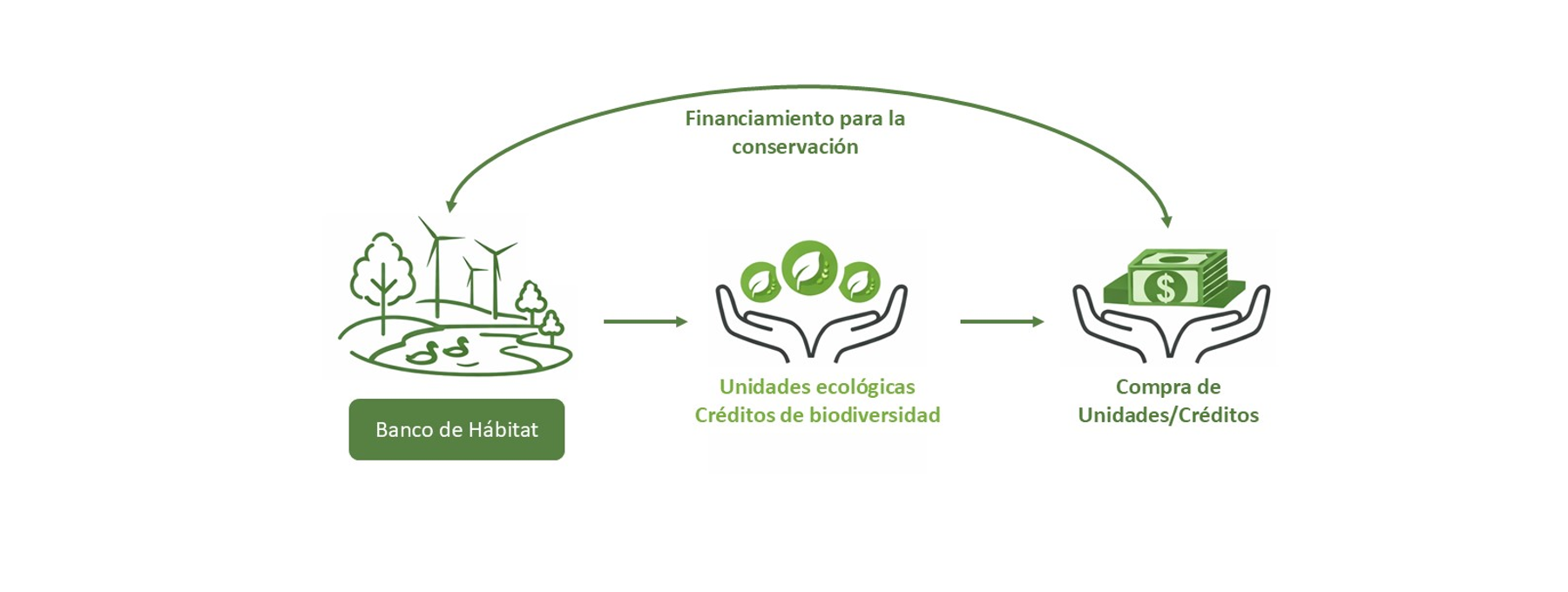
What is the legal framework in Peru for habitat banks?
In Peru, there is not yet a fully developed Habitat Banking system; however, the concept is recognized within the technical framework of environmental compensation. The relevant references are found in the “Guía para la Compensación Ambiental en el marco del SEIA” published by the Ministry of the Environment (2024).
Within this guide:
• Section 7 – Environmental Compensation Actions: habitat banks are explicitly classified as one of the actions that a project proponent may propose to offset authorized residual impacts through “Compensation Units.”
• Complementary regulatory framework: the guide establishes that their development and operation must be subject to specific regulation issued by MINAM. This implies that, although the tool is recognized, its detailed operability depends on complementary regulation.
Compensation Units: from a regulatory to an economic perspective
A key point is that, under the current regulatory framework, Compensation Units (CUs) are not defined as tradable assets in an open market, but rather as a technical metric used to quantify and ensure ecological equivalence within the SEIA administrative process.
Consequently, Compensation Units:
- Do not have legal treatment as an asset.
- Do not have a transfer regime between private parties.
This limits the development of structured advance-supply schemes that could be generated through habitat banks or other territorial conservation mechanisms.
From an economic theory perspective
Allowing the transaction of Compensation Units would generate:
- Efficient allocation of compensation costs: Developers could acquire units where the marginal restoration cost is lower.
- Ecological economies of scale: Concentrating compensations in strategic areas enables greater connectivity and less fragmentation.
- Reduction of transaction costs: Avoids each project designing its own compensation in isolation.
- Attraction of capital toward conservation.
Likewise, if Compensation Units could be structured as regulated assets:
- Private investment in advance restoration through territorial conservation mechanisms would be enabled.
- Conservation trusts could be structured.
- Financing based on future unit sales could be facilitated.
- Incentives would be created to identify and restore degraded areas before specific demand exists.
Final reflection
In summary, transactionality turns conservation into investable infrastructure. The next step—should Peru decide to move in this direction—would be institutional: defining whether Compensation Units will remain administrative metrics within SEIA or evolve into tradable instruments under a regulated regime.
The difference is structural, not semantic.