




Introductory note
The following analysis is a conceptual exercise. Its objective is to explain the theoretical relationship between habitat banks and biodiversity credits from an international comparative perspective.
In the current Peruvian context, there is no legal framework that recognizes “biodiversity credits” or “compensation units” as formally tradable instruments within a regulated market. Nor is there, to date, a specific regulatory regime governing habitat banks.
Therefore, the categories developed below should be understood as analytical constructs used to explore how such a system could be structured in the future, rather than as a description of the current legal framework in Peru.
How do habitat banks relate to biodiversity credits?
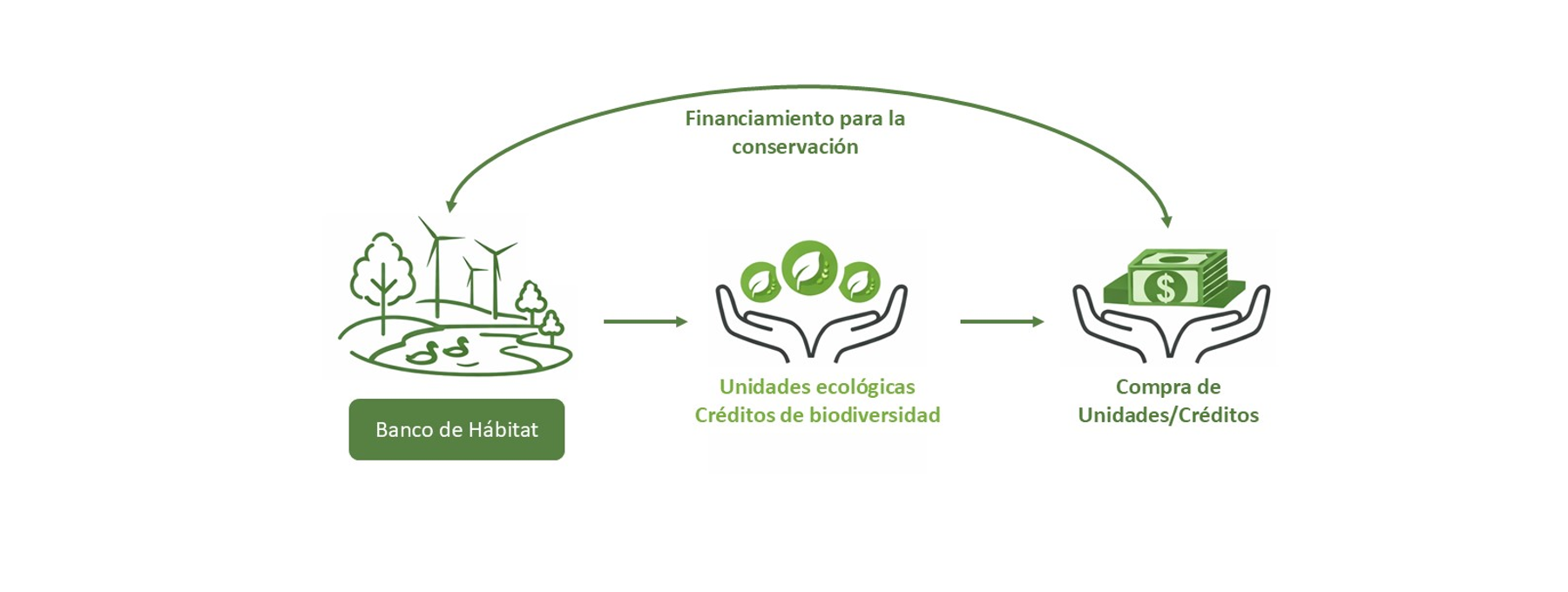
The relationship between a Habitat Bank and biodiversity credits is that of a system and its product: the Habitat Bank is the system; biodiversity credits are the product.
This relationship is expressed across four key dimensions:
1. Asset generation: The bank implements conservation or restoration actions in strategic areas and transforms verified ecological improvements into tradable units. The credit represents a result managed over time, not merely a surface area.
2. Types of Units: Depending on the market, conceptually they may issue:
- Compensation units (regulated market): to fulfill legal obligations under ecological equivalence principles.
- Biodiversity credits (voluntary market): to generate net biodiversity gain without a prior mandatory impact.
3. Results-Based Payment: Credits or units may only be released once verifiable ecological performance milestones are achieved, certified by the authority or an independent third party.
4. Long-Term Commitment: Unlike other environmental assets, these units require sustained ecological management (20–30 years). They are not one-off reductions, but structural maintenance of natural infrastructure.
What advantages do habitat banks offer compared to other biodiversity credit issuers?
Habitat Banks offer structural advantages over isolated NGO projects or direct corporate compensation schemes because they are not one-off interventions, but planned ecological infrastructure secured over the long term.
Their main advantages include:
1. Greater ecological integrity: They allow multiple compensations to be concentrated in strategic areas, promoting connectivity and landscape-scale restoration. Mitigation is often implemented in advance, reducing the time lag between impact and recovery.
2. Legal and financial certainty: They require proper land tenure regularization and financial mechanisms (such as trusts) that guarantee project permanence for 20–30 years or more. This reduces legal risks and ensures long-term maintenance funding.
3. Payment for verified results: Credits are only released once measurable ecological milestones are achieved and verified by the authority or an independent third party. Payment is made for performance, not intention.
4. Operational efficiency and risk reduction: In mature markets, purchasing credits can transfer legal liability for impacts to the bank operator. It also simplifies compliance for companies and generates economies of scale that reduce costs compared to fragmented projects.
In summary, Habitat Banks represent a high-integrity conservation asset backed by a technical, legal, and financial structure designed to endure for decades.
Which companies operate habitat banks in Latin America?
Terrasos (Colombia, with regional expansion)
The leading and pioneering company in Latin America. It developed and operates the first habitat bank in the region (Orinoquía / Meta Habitat Bank, since 2018). It currently manages more than 12–16 habitat banks across several Colombian departments (Meta, Antioquia, Cesar, Casanare, among others), administering thousands of hectares (over 7,000–8,000 hectares registered, with more under structuring).
South Pole (International, with projects in Colombia)
Operates the Alto de Ventanas project, one of the first habitat banks in Colombia focused exclusively on restoration (registered in 2024). South Pole is a global climate and biodiversity advisory firm entering the regional habitat banking market.
MorphoBDC (Colombia)
A company providing comprehensive services related to habitat banks, including biodiversity credit acquisition and compensation structuring. It acts as both facilitator and operator within the Colombian ecosystem.